FabuLingua
Release owner and senior engineer on a live kids' language-learning app on iOS, Android and the web: built the Echo Hunt mini-game, moved subscriptions to Adapty and shipped versions 2.0.16 to 2.2.0.

Results
- Releases shipped
- 2.0.16 → 2.2.0
- As release integrator, on iOS, Android and WebGL
- Story audio
- 5,720 clips
- Seeded into a cloud audio registry with 0 failures
- Spanish syllables
- 632 clips
- Syllable library moved to 100% Ogg, with real ñ syllables
A story-based language-learning app for young kids. Children play illustrated, narrated stories where every word is tappable and voiced, then practise in mini-games along a map of locations. Families subscribe and classrooms join through Clever. I build features, payments and editor tools, and I integrate and ship each release to iOS, Android and WebGL.
Senior engineer across gameplay, UI, payments, compliance, builds and editor tools, and the release owner who integrates and ships each version.
Overview
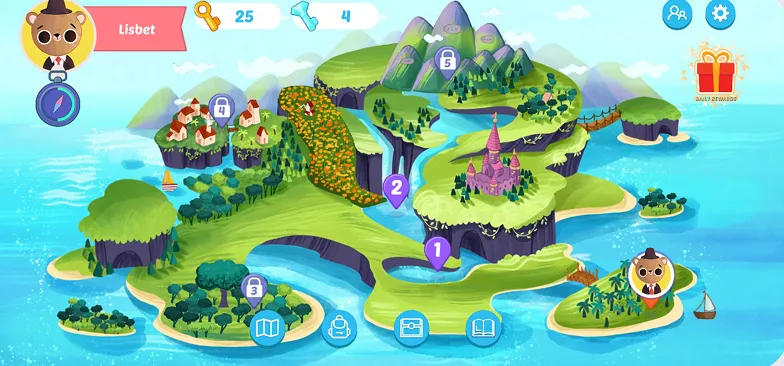
FabuLingua teaches young kids a second language through illustrated, narrated stories. Every word is tappable and voiced, and the stories feed mini-games on a map of locations. It is live on iOS, Android and the web, for families and for classrooms.
My early work, in 2023–2024, was editor tooling and general app improvements: an AI deck-generation editor tool, an audio–text sync tool and fixes across the app.
Today I work across the whole app. I built the Echo Hunt mini-game, rebuilt the sticker book in UI Toolkit, moved subscriptions to Adapty, did the Play Families and COPPA compliance work, and wrote the editor tools the team uses for audio, stories and builds. I also own releases: I integrate the team’s work and ship each version to all three platforms.
What I owned
Gameplay & UI
- Echo Hunt, a mini-game built end to end: an endless parallax world, a sentence bank drawn from the story pages by difficulty, Spanish and English text–audio sync, tutorial, localization and themes.
- A session-scoped, strongly typed event bus for the mini-games in place of static events.
- The sticker book rebuilt in UI Toolkit: manipulators, a dynamic grid, an album view and a colour palette, plus texture and memory leak fixes.
- A data-driven story hint system, with existing stories migrated automatically by editor scripting and an audit report.
- App text migrated to Unity Localization.
Payments, Compliance & Accounts
- Adapty as the source of truth for premium, a resumable, idempotent migration of legacy store subscribers that verifies with the store before writing, and a hardened purchase flow: one outcome per purchase, timeout and re-entrancy guards, and an in-editor outcome simulator.
- Google Play Families and COPPA compliance: device and advertising identifiers removed and every SDK configured for kids.
- Adjust migrated from v4 to v5 behind a single SDK bootstrap.
- Clever SSO students get classroom entitlements on WebGL instead of the consumer paywall.
- A reliability pass: shared failure popups, guarded state transitions and recovery paths for login, profiles, location loading and content downloads.
Editor Tools
- Audio Studio: AI voice generation inside Unity, with take history, batch generation from word lists, provenance on every clip and in-editor Ogg transcoding.
- Stories Dashboard for per-story settings, page text, interactions and reward screens.
- Receipt Rescue, a support tool that decodes legacy store receipts, verifies them with Apple and Google and imports them into the subscription backend.
- Build Hub for build automation and per-platform content uploads, plus validators that fail a build missing its WebGL Addressables output or a scene missing its location setup.
- Animation tools: AmbientMotion for idle, travel and tap motion with a live inspector preview, and ChainSway, a bendable sprite on a Verlet chain for vines, seaweed and tails.
Builds & Releases
- Release integrator for versions 2.0.16 to 2.2.0 on iOS, Android and WebGL, including the WebGL release train and hotfixes.
- Unity Cloud Build for all three platforms: one owner for the store build number, post-build guards and a TestFlight upload that fails the build on error.
- Localization string tables preloaded on WebGL, with a build validator so a release can't ship without its Addressables content.
Where AI fit in
- AI coding agents
- Second-model review
- Editor automation
- AI asset pipeline
Larger tools start as a written spec and a task-by-task plan, and visual features are explored in an HTML prototype lab before any Unity work. AI coding agents work on a feature branch; a second model proposes alternatives and reviews code from a sandbox folder, and I review every check-in. Agents verify changes in the live editor (Play mode, screenshots at device resolutions, the console) under hard rules: no code edits during Play and no saving open scenes. Self-tests, purchase simulators and build validators catch bad output, and a project knowledge graph and wiki keep the agents' architecture answers grounded.